Effective Bits in Name Only: When Your 24-Bit ADC Is Secretly Performing at 14
Purchasing a 24-bit analog-to-digital converter carries an implicit promise: sub-microvolt resolution, dynamic range exceeding 140 dB, and measurement fidelity that should satisfy virtually any precision instrumentation requirement. For a significant fraction of deployed systems, that promise is broken before the first measurement is recorded — not because the silicon is defective, but because the environment surrounding it is hostile to the resolution it was designed to deliver.
Understanding why effective resolution degrades, how to quantify the degradation, and what practical steps restore meaningful bit depth is among the more consequential — and underappreciated — competencies in precision signal acquisition engineering.
The Distance Between Nominal and Effective
The distinction between a converter's nominal resolution and its effective number of bits (ENOB) is not an abstraction. It is a measurable, quantifiable performance gap that determines whether a measurement system is fit for its intended purpose.
ENOB is derived from the signal-to-noise-and-distortion ratio (SINAD) of the converter under actual operating conditions. The relationship is straightforward: ENOB = (SINAD − 1.76) / 6.02. A 24-bit converter with a theoretical SINAD of approximately 146 dB would achieve an ENOB near 24 in a noise-free, thermally stable environment with a perfect power supply and ideal grounding. In the field — or even on a well-intentioned but imperfectly executed lab bench — SINAD values of 86 to 90 dB are common, yielding effective resolutions in the 14 to 15-bit range.
The 10-bit gap between the nameplate and the reality represents a factor of roughly 1,000 in amplitude resolution. It is not a minor calibration offset. It is a fundamental limitation on the information content of every sample the system produces.
Thermal Noise: The Irreducible Floor
Johnson-Nyquist noise — the thermal agitation of charge carriers in any resistive element — establishes an absolute noise floor that no circuit technique can eliminate, only manage. For a resistor at room temperature, the RMS noise voltage is proportional to the square root of both resistance and measurement bandwidth. At the input of a high-resolution ADC, even modest source impedances contribute noise that may exceed the converter's least-significant-bit voltage.
Consider a 24-bit ADC with a 5 V full-scale range. Its LSB voltage is approximately 298 nanovolts. A 1 kΩ source resistance in a 10 kHz measurement bandwidth generates roughly 13 nanovolts RMS of thermal noise — comfortably below the LSB. Increase that bandwidth to 1 MHz, however, and the same source resistance contributes approximately 130 nanovolts — still below the LSB, but now consuming a meaningful fraction of the noise budget. Add the input amplifier's own voltage noise, the reference voltage noise, and parasitic resistance contributions from PCB traces and connector contacts, and the thermal noise floor of a real system routinely occupies three to five LSBs of the 24-bit range.
The practical consequence: true 24-bit performance requires extraordinary attention to source impedance, bandwidth limiting, and thermal management — not as optional refinements, but as prerequisites.
Power Supply Contamination
Switching power supplies are ubiquitous in modern instrumentation, and they are among the most effective destroyers of ADC dynamic range in practice. A switching regulator operating at 500 kHz will inject ripple and switching noise at that frequency and its harmonics into the analog supply rail of a converter. Even at millivolt amplitudes — well within the regulation specifications of a competent supply — this noise couples directly into the converter's reference voltage, its analog input stage, and its internal bias circuitry.
A 1 mV ripple on the reference voltage of a converter with a 5 V full-scale range introduces a relative error of 200 parts per million. For a 24-bit converter, that corresponds to approximately 3,355 LSBs — a degradation of roughly 12 bits. The converter is now, for practical purposes, a 12-bit device, regardless of what the datasheet claims.
Low-dropout linear regulators, post-regulation RC filters with cutoff frequencies well below the switching frequency, and careful separation of analog and digital supply domains are the standard mitigations. What is less commonly appreciated is that these measures must be validated, not assumed. Post-installation SINAD measurement is the only reliable confirmation that supply contamination has been adequately suppressed.
Ground Plane Architecture and Its Consequences
Digital circuitry generates current transients with risetimes measured in hundreds of picoseconds. Those transients flow through the ground plane, developing millivolt-scale voltage gradients across the finite impedance of even well-designed copper pours. When the analog return path of an ADC shares ground plane area with high-speed digital logic — FPGAs, microcontrollers, DDR memory interfaces — the converter's analog ground reference is modulated by digital switching noise at rates that can span the converter's full input bandwidth.
The resulting noise is neither random nor easily filtered. It is structured, correlated with digital activity, and often broadband. It appears in the converter's output as elevated noise floor, spurious tones at clock harmonics, and nonlinearity that varies with the digital workload of the host system. Engineers who characterize their ADC with a simple sinewave test during bench evaluation — before the surrounding digital logic is fully operational — will measure ENOB values that are genuinely unachievable in the deployed system.
Star-point grounding, split ground planes with controlled single-point connections, and physical separation of analog and digital domains on the PCB are foundational mitigations. Validation should be performed with all digital subsystems running at maximum activity, not in idle states.
Diagnosing Effective Resolution in the Field
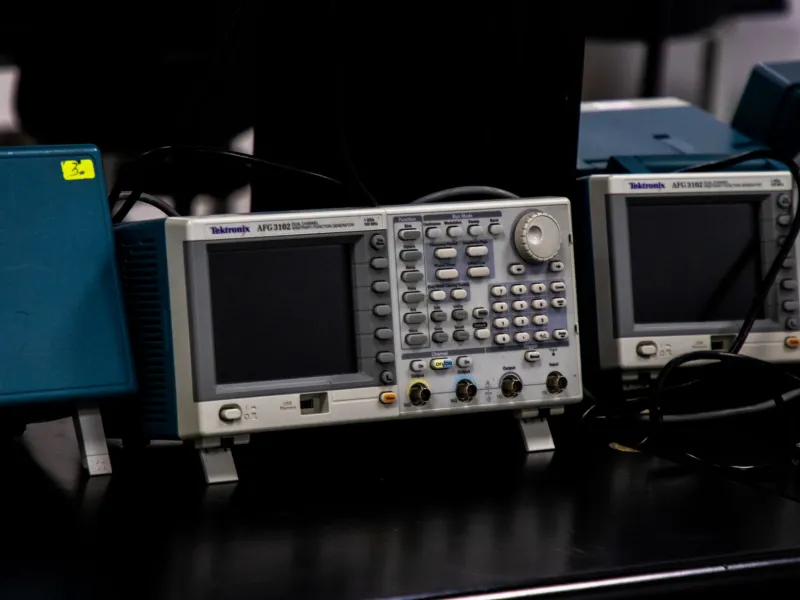
Characterizing true ENOB in a deployed system requires a disciplined measurement protocol. The standard approach applies a spectrally pure sinusoidal input — generated by a low-distortion source with noise performance that exceeds the converter under test — at a frequency that exercises the full input bandwidth. The converter's output is captured over a sufficient record length to resolve the noise floor, and the SINAD is computed from the ratio of the fundamental signal power to the total noise-plus-distortion power.
For field diagnostics where a precision sine source is unavailable, a useful proxy is the noise-only measurement: apply a stable DC voltage near mid-scale and compute the RMS variation of the converter output over a statistically meaningful sample count. Dividing the full-scale range by the observed RMS noise and expressing the result in bits provides an approximate ENOB that, while not equivalent to the full SINAD-based calculation, quickly reveals catastrophic resolution degradation.
Histogram testing — applying a precise ramp or triangular wave and examining the distribution of output codes — provides complementary information about differential nonlinearity and missing codes that SINAD measurements alone may obscure.
Reclaiming Resolution
When ENOB measurements reveal significant degradation, the diagnostic path follows the noise budget hierarchy: power supply contamination, ground plane integrity, thermal noise from source impedance, and finally the converter's own internal noise floor. Addressing contributors in that order typically yields the fastest recovery of effective resolution per unit of engineering effort.
Oversampling and decimation offer a signal-processing path to improved effective resolution when bandwidth can be traded for dynamic range — a well-established technique that recovers approximately half a bit per factor-of-four increase in oversampling ratio. It is a useful tool, but it does not substitute for the elimination of structured noise sources. Oversampling averages random noise effectively; it does not average away periodic supply ripple or correlated digital switching artifacts.
The 24-bit ADC is a remarkable device. Treating its nameplate resolution as a delivered specification, rather than a theoretical maximum requiring deliberate engineering to approach, is how organizations end up paying premium prices for 14-bit measurement performance.