When Clocks Lie: The Cascading System Consequences of Oscillator Phase Noise
Every oscillator lies. Not dramatically—no catastrophic frequency collapse, no obvious distortion. The deception is subtler: a slow, stochastic drift in the phase of an otherwise well-behaved sinusoid. Engineers call it phase noise, and in isolation it can seem like a minor imperfection buried in a datasheet footnote. Across a complete signal chain, however, it compounds in ways that frequency-domain specifications alone almost never predict.
Understanding phase noise is not merely academic. In precision radar, it limits clutter rejection. In coherent communications, it collapses error vector magnitude budgets. In emerging quantum computing hardware, it can corrupt qubit control pulses in ways that are maddeningly difficult to trace back to the clock reference. The cost of ignoring it—measured in redesign cycles, failed qualifications, and lost system margin—is consistently higher than the cost of addressing it early.
Defining the Problem: What Phase Noise Actually Measures
Phase noise is formally expressed as £(f), the ratio of single-sideband noise power in a 1 Hz bandwidth at an offset frequency f from the carrier, normalized to the carrier power. The units are dBc/Hz. A well-specified oscillator datasheet will present a curve of £(f) across a range of offsets—typically from 1 Hz to 10 MHz—revealing how rapidly the noise floor falls as you move away from the carrier.
The shape of that curve is not arbitrary. It reflects the underlying noise mechanisms in the oscillator's sustaining amplifier and resonator. Close-in phase noise, typically dominant from 1 Hz to a few kilohertz, follows a 1/f³ slope driven by flicker noise upconversion. Further out, 1/f² behavior dominates as thermal noise modulates the oscillator phase. Beyond the resonator's half-bandwidth, the noise floor flattens to a white phase noise level set by the amplifier's noise figure.
This slope structure matters enormously when predicting downstream effects. A system architect who only checks the noise floor at a single offset—say, 100 kHz—may completely miss the close-in spur structure that will devastate a Doppler radar's velocity resolution or corrupt a narrow-band receiver's adjacent-channel performance.
Measurement Discipline: Getting Accurate Numbers
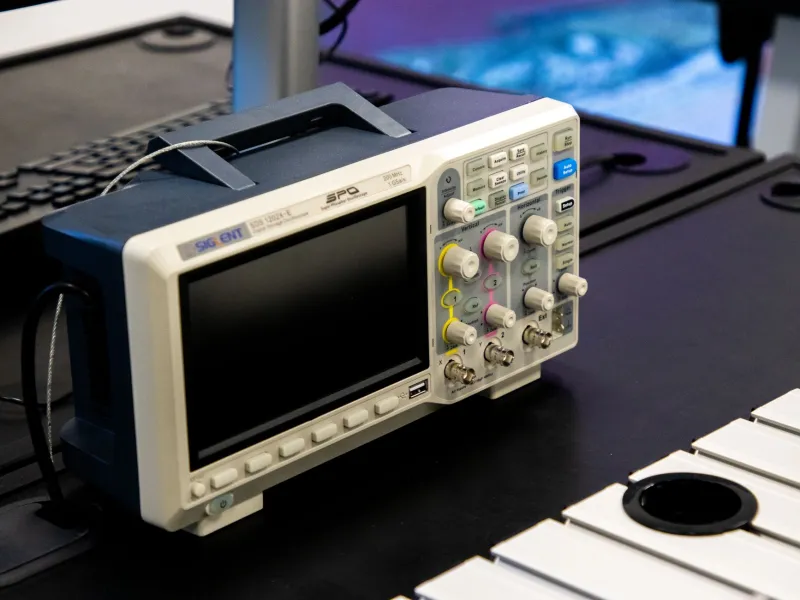
Measuring phase noise correctly requires more care than many bench setups provide. The two dominant techniques are the direct spectrum method and the reference source method, sometimes called the cross-correlation or two-channel method.
The direct spectrum approach—simply observing the carrier on a spectrum analyzer—is fast but limited. The analyzer's own local oscillator phase noise sets the noise floor of the measurement. For many modern, low-noise crystal oscillators and VCXOs, the instrument's self-noise overwhelms the device under test at close-in offsets, producing optimistic and entirely misleading results.
The reference source method, implemented in dedicated phase noise analyzers from vendors such as Keysight, Rohde & Schwarz, and Holzworth, uses a low-noise reference to beat against the device under test, shifting the measurement into the baseband where a low-noise amplifier and ADC can resolve the phase fluctuations directly. Cross-correlation averaging across two independent channels further suppresses the instrument noise floor by 5 dB per decade of averages, enabling measurements that approach −180 dBc/Hz at 10 kHz offset for the best instruments available today.
For engineers without access to a dedicated phase noise analyzer, a signal source analyzer or even a carefully configured vector signal analyzer can provide useful data, provided the instrument's noise floor is characterized and accounted for in the measurement uncertainty budget.
How Phase Noise Propagates: The Cascade Nobody Draws
The real damage begins when an imperfect oscillator drives downstream components. In a superheterodyne receiver, the local oscillator's phase noise mixes with incoming signals and translates directly onto the IF. A strong adjacent-channel interferer, riding through the mixer, can skirt its phase noise sidebands directly onto the desired signal—a phenomenon called reciprocal mixing. The result is a degraded noise figure that no amount of IF filtering can recover.
In radar systems, the consequence is even more direct. Pulse-Doppler radars depend on coherent integration across multiple pulses to discriminate moving targets from stationary clutter. The oscillator's phase noise sets the coherent processing interval limit: once the integrated phase error exceeds roughly 0.1 radians, the coherent gain advantage begins to erode. For a radar attempting 60 dB of clutter rejection, even a seemingly respectable oscillator with −130 dBc/Hz at 1 kHz offset can become the binding constraint.
In frequency synthesizers built around phase-locked loops, the relationship between oscillator phase noise and output phase noise is governed by the PLL's closed-loop transfer function. Inside the loop bandwidth, the output phase noise tracks the reference oscillator's noise multiplied by 20·log(N), where N is the divide ratio. Outside the loop bandwidth, the VCO's free-running noise dominates. Getting this transition right—matching loop bandwidth to the crossover point where reference noise and VCO noise are equal—is one of the most consequential decisions in PLL design, and one that demands accurate phase noise models for both the reference and the VCO.
Quantum computing hardware introduces yet another failure mode. Microwave control pulses used to drive superconducting qubits must maintain phase coherence over gate durations that can span hundreds of nanoseconds. Phase noise in the control oscillators translates into stochastic rotation errors on the Bloch sphere, degrading gate fidelity in ways that mimic decoherence and are extremely difficult to distinguish from intrinsic qubit noise. Research groups at institutions including MIT Lincoln Laboratory and NIST have begun treating oscillator phase noise as a first-class design constraint in qubit control electronics—a discipline that commercial quantum hardware developers are now adopting as they scale toward error-corrected systems.
Mitigation Strategies: A Practical Framework
Addressing phase noise effectively starts with oscillator selection. For fixed-frequency applications, bulk acoustic wave (BAW) and surface acoustic wave (SAW) oscillators offer substantially lower close-in phase noise than LC-based alternatives. Oven-controlled crystal oscillators (OCXOs) remain the gold standard for applications demanding the lowest possible noise floor at close-in offsets, with top-tier units from manufacturers such as Wenzel Associates and Vectron achieving £(f) below −170 dBc/Hz at 10 kHz offset.
When a synthesizer is unavoidable, PLL architecture choices carry significant weight. Fractional-N synthesizers offer fine frequency resolution but introduce quantization noise from the sigma-delta modulator that can raise the in-band phase noise floor substantially. Integer-N designs avoid this penalty at the cost of coarser step size. For applications where both fine resolution and low noise are mandatory, dual-loop architectures or direct digital synthesis (DDS) combined with a clean-up PLL can provide a practical compromise.
Low-noise PLL design also demands attention to the charge pump, loop filter, and VCO supply rejection. Charge pump current mismatch creates reference spurs; inadequate supply bypassing on the VCO allows power supply noise to modulate the output frequency through the tuning port's implicit sensitivity to rail variations. These second-order effects routinely account for 10–15 dB of unexplained noise floor degradation in first-pass designs.
Finally, system-level phase noise budgeting—analogous to the link budgets that RF engineers routinely construct—should be a standard deliverable in any design that depends on a timing reference. Allocating phase noise across the oscillator, PLL, and distribution network, then verifying each allocation with measurement, converts phase noise from an afterthought into a managed parameter.
Conclusion
Phase noise is not a footnote. It is a system-level design variable that silently sets the ceiling on radar sensitivity, receiver selectivity, synthesizer cleanliness, and the fidelity of next-generation quantum hardware. Engineers who treat it as such—quantifying it rigorously, measuring it honestly, and budgeting it explicitly—consistently build systems that perform where others fail. The oscillator in your design is telling you something. The question is whether you are listening at the right offset frequency.