Aperture Uncertainty: The Timing Flaw Inside Your ADC That Datasheet Specs Won't Warn You About
Aperture Uncertainty: The Timing Flaw Inside Your ADC That Datasheet Specs Won't Warn You About
Every analog-to-digital converter makes a promise: at a defined moment in time, it will freeze the input signal and convert that frozen value into a digital word. The operative phrase is defined moment. In reality, the instant at which a sample-and-hold circuit actually captures the input is not perfectly deterministic. It wanders—cycle to cycle, device to device—by a small but consequential interval. That wandering is aperture uncertainty, and in high-speed data acquisition systems, it is quietly responsible for a category of signal corruption that too many engineers are still attributing to the wrong cause.
What the Sample-and-Hold Circuit Is Actually Doing
The sample-and-hold (S/H) stage is the front door of any ADC. When the hold command arrives, a switch opens, isolating the sampling capacitor from the input, and the voltage across that capacitor is presented to the quantizer. The precision of the entire conversion depends on how accurately the switch opens relative to the intended sampling instant.
Aperture delay is the predictable, systematic offset between the clock edge and the actual moment of capture. It is reproducible and, in principle, correctable through timing adjustments. Aperture uncertainty—also called aperture jitter—is the stochastic component: random, cycle-to-cycle variation in that delay. It is this random element that cannot be calibrated away. Every time the clock fires, the true sampling instant lands somewhere within a probability distribution centered on the nominal aperture delay. The width of that distribution is what manufacturers specify as aperture uncertainty, typically expressed in root-mean-square picoseconds.
From Timing Error to Amplitude Error
The translation from timing uncertainty to amplitude error is governed by a straightforward but sobering relationship. If a sinusoidal input of frequency f and amplitude A is sampled with an aperture uncertainty of t_a (rms), the resulting voltage error is approximately:
ΔV ≈ 2π · f · A · t_a
This is simply the product of the signal's maximum slope and the timing uncertainty. The error grows linearly with both input frequency and aperture jitter. At low frequencies, the slope is gentle and a few picoseconds of uncertainty produce negligible amplitude error. Push the input frequency into the hundreds of megahertz, however, and the math becomes unforgiving.
Consider a 14-bit ADC with a full-scale input of 2 V peak-to-peak and a specified aperture uncertainty of 100 fs rms—a respectable figure for a modern converter. At 10 MHz, the timing-induced voltage error is approximately 6.3 µV, well below the LSB. At 500 MHz, that same 100 fs produces roughly 315 µV of error, which corresponds to more than one LSB at 14 bits. The converter's resolution has effectively been truncated by the physics of its own sampling front end, regardless of how clean the power supply is or how carefully the board has been laid out.
Why Engineers Keep Misdiagnosing the Problem
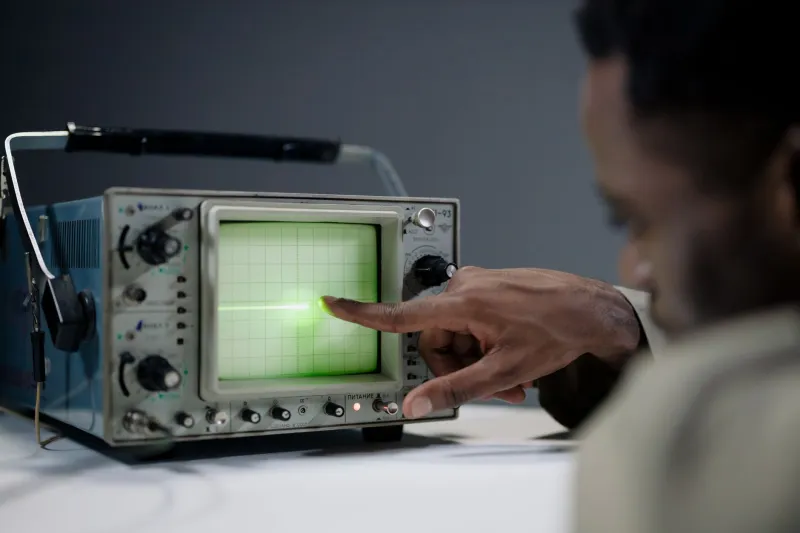
Aperture jitter manifests as elevated noise in the frequency domain, and that is precisely the problem. When an engineer observes a degraded signal-to-noise ratio that doesn't improve with better grounding, quieter power rails, or increased averaging, the instinct is often to blame the analog input path, the reference voltage, or electromagnetic interference. All of those are legitimate suspects. Aperture uncertainty is not typically the first hypothesis because it is invisible to standard bench diagnostics. You cannot probe it directly with an oscilloscope without introducing measurement uncertainty that swamps the effect you are trying to observe.
The SNR degradation attributable to aperture jitter follows a well-defined relationship:
SNR_aperture ≈ -20 · log₁₀(2π · f · t_a)
For a 1 GHz input signal and 100 fs of aperture jitter, this formula yields an aperture-limited SNR ceiling of approximately 64 dB—regardless of the converter's bit depth. A 16-bit ADC with a theoretical dynamic range of 98 dB is architecturally incapable of delivering that performance under these conditions. The datasheet's noise floor specification, which is typically characterized at low input frequencies, tells you almost nothing about behavior at the frequencies that matter most in wideband applications.
Reading Between the Lines of the Datasheet
Most ADC datasheets publish SNR as a function of input frequency, and this curve is where aperture uncertainty reveals itself—if you know what to look for. A well-characterized device will show SNR declining at a rate consistent with the aperture jitter formula as input frequency increases. If the published curve rolls off faster than thermal noise alone would predict, aperture jitter is the dominant mechanism.
Some manufacturers specify aperture uncertainty directly. Others embed it implicitly in their high-frequency SNR figures, leaving the engineer to back-calculate the effective jitter. For system validation purposes, neither approach is sufficient on its own. The only reliable method is to characterize the converter in your specific circuit, with your specific clock source, at the input frequencies your application actually uses.
Clock quality deserves particular emphasis here. The aperture uncertainty specified on a datasheet typically assumes a low-jitter clock input. Any phase noise or jitter introduced by the system clock adds in quadrature to the converter's intrinsic aperture uncertainty. A sampling clock with 500 fs of rms jitter will dominate the aperture error budget of even the most capable ADC. In practice, this means that clock generation and distribution deserve at least as much engineering attention as converter selection itself.
Mitigation Strategies Across Application Domains
In radar and electronic warfare applications, where wideband receiver chains routinely sample signals well above 1 GHz, aperture uncertainty is a first-order design constraint. Interleaved ADC architectures can extend effective sampling rates, but they introduce their own timing mismatch errors between channels that must be calibrated carefully. Low-jitter sampling clocks derived from oven-controlled oscillators (OCXOs) or disciplined by atomic references represent the current best practice for minimizing the combined aperture error budget.
In precision instrumentation, where dynamic range rather than bandwidth is often the primary objective, the strategy shifts toward operating the ADC at input frequencies well below the aperture-limited SNR boundary. Oversampling and decimation can recover effective resolution, but only if the aperture jitter floor is below the thermal noise floor at the oversampled rate. Designers who assume that oversampling alone will compensate for a mediocre sampling front end will be disappointed.
In communications receivers, particularly those implementing direct RF sampling architectures for software-defined radio platforms, aperture uncertainty directly limits the achievable dynamic range in the presence of strong adjacent-channel signals. Converter selection for these applications must account for high-frequency SNR performance under realistic signal conditions, not just sensitivity figures derived from single-tone testing at low input frequencies.
Across all domains, the mitigation toolkit includes: selecting converters with explicitly characterized and minimized aperture jitter; using the lowest-jitter clock source the system budget permits; minimizing clock path length and avoiding logic gates in the sampling clock distribution; and validating SNR performance empirically at the actual input frequencies of interest rather than relying on extrapolation from datasheet figures.
The Measurement Problem
Characterizing aperture uncertainty in a production environment is genuinely difficult. The most rigorous method involves driving the ADC with a spectrally pure sinusoidal input at the target frequency, computing the FFT of a long capture, and comparing the measured SNR against the theoretical thermal noise floor. The difference, after accounting for distortion products, reflects the aperture jitter contribution. This requires a signal source with jitter well below the ADC's aperture uncertainty—typically a low-phase-noise synthesizer disciplined to a high-quality reference—and a test environment that controls for board-level parasitics.
For engineers who lack access to that level of test infrastructure, a practical alternative is to compare SNR measurements taken at two widely separated input frequencies using the same converter and clock. The frequency dependence of the SNR rolloff will reveal whether aperture jitter or some other mechanism is the dominant degradation source.
Conclusion
Aperture uncertainty is not a peripheral concern for specialists in exotic applications. It is a fundamental physical limitation that affects every high-speed data acquisition system operating above a few tens of megahertz. As input frequencies continue to climb across radar, communications, and instrumentation platforms, the gap between what a converter's bit depth implies and what aperture jitter permits will only widen. Engineers who understand the underlying physics, know how to read the relevant datasheet parameters critically, and validate performance under realistic operating conditions will build systems that actually deliver the dynamic range their designs require. Those who rely on thermal noise budgets and low-frequency bench measurements will keep chasing a problem they cannot find.