The Waveform Never Lies: Why Hands-On Oscilloscope Discipline Is Irreplaceable in the Age of Automated Signal Analysis
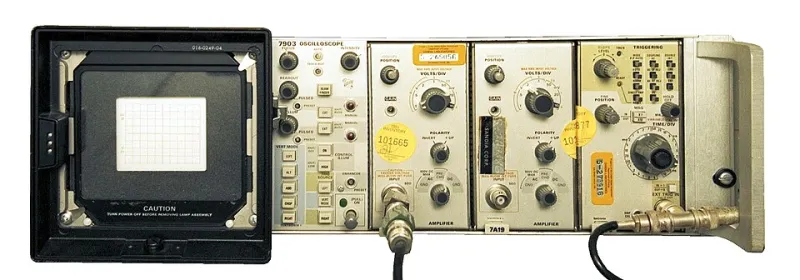
Photo: Department of Energy. National Nuclear Security Administration. Sandia National Laboratories. 3/1/2000, Public domain, via Wikimedia Commons
There is a particular kind of engineering intuition that develops only through years of staring at waveforms. It is the instinct that notices something wrong in the shape of a rising edge before any automated measurement flag has triggered. It is the recognition that a noise floor that looks clean in the frequency domain is hiding structured content in the time domain—content that a well-configured oscilloscope will reveal in seconds. It is, increasingly, a skill that the engineering profession is at risk of losing.
The automation of signal analysis is not, in itself, the problem. Automated test equipment, AI-assisted anomaly flagging, and cloud-based signal processing platforms represent genuine productivity gains for well-characterized, high-volume test scenarios. The problem is the epistemological drift that accompanies automation—the gradual substitution of algorithmic confidence for physical understanding. When an engineer trusts a measurement because the software reported it, rather than because they understand the signal well enough to verify it independently, the lab has traded competence for convenience.
What Algorithms Cannot See
Automated signal analysis operates on defined measurement primitives: rise time, fall time, frequency, amplitude, jitter statistics. These metrics are extracted from waveforms according to fixed algorithms, and they are reported with apparent precision that can be deeply misleading when the underlying signal violates the assumptions embedded in the measurement algorithm.
Consider a digital serial link that is intermittently exhibiting bit errors. An automated compliance test suite will measure rise time, eye height, and eye width, compare them against specification limits, and report pass or fail. If the link passes, the automated system has nothing more to say. But an engineer examining the eye diagram directly—particularly one with experience reading the temporal structure of jitter—may notice that the eye closure is not symmetric. The jitter distribution has a tail on one side that the aggregate RMS jitter figure conceals. That asymmetry is a physical clue: it suggests a periodic interference source, possibly a switching regulator or a clock harmonic, that the automated jitter decomposition algorithm has misclassified as random noise.
This is not a failure of the automated tool. It is a failure of the measurement framework to capture physical reality with sufficient fidelity. The tool is reporting what it was designed to report. The engineer who understands the physics knows that the reported metric is not the right question.
The Transient Problem
Transient phenomena represent perhaps the most significant blind spot in automated signal analysis workflows. A transient event—a glitch, a runt pulse, an anomalous undershoot following a switching edge—may occur once in ten million clock cycles. Automated statistical measurements, which aggregate behavior across many acquisitions, will dilute any transient artifact into insignificance. The reported metrics will look normal because, statistically, they are normal.
Oscilloscopes equipped with hardware-accelerated waveform capture and persistence display modes have the capability to reveal these transients—but only if the engineer is watching for them and has configured the instrument appropriately. Infinite-persistence display, combined with a carefully chosen trigger condition, will accumulate rare events over time and make them visible as faint traces overlaid on the dominant waveform. This is a technique that requires both instrument knowledge and interpretive skill. It cannot be delegated to an automated analysis script that runs a fixed sequence of measurements and generates a report.
Field engineers at several US semiconductor companies have documented cases where intermittent field failures were traced to transient events visible only under infinite-persistence capture—events that had been invisible to automated test systems for months of production testing. In each case, the diagnosis required an engineer who knew what to look for and how to configure the instrument to reveal it.
The Pedagogy Gap
The skills required for effective oscilloscope-based diagnosis are not intuitive. They are learned through deliberate practice, through mentorship, and through the accumulation of experience across many different circuit topologies and failure modes. They are also, increasingly, skills that are not being systematically taught.
University electrical engineering curricula in the United States have, over the past two decades, progressively reduced the laboratory hours devoted to bench instrumentation in favor of simulation tools and software-defined analysis environments. The rationale is understandable: simulation tools are cheaper to maintain than physical lab equipment, and they can be accessed remotely. But simulation operates on models, and models are only as good as their parameters. The oscilloscope operates on reality.
Several research groups are pushing back against this trend in ways worth noting. At a power electronics laboratory at a major Midwestern research university, graduate students are required to complete a structured oscilloscope proficiency program before they are permitted to use automated test equipment for any measurement. The program covers probe selection and compensation, trigger configuration for low-repetition-rate events, bandwidth and sample rate interaction, and the interpretation of persistence displays. The rationale, as the laboratory director explained in a recent conference presentation, is simple: an engineer who cannot read a waveform cannot tell whether their automated measurement is correct.
A similar philosophy is evident in the engineering culture at several US defense contractors working on radar and electronic warfare systems, where the complexity and novelty of signal environments routinely outpace the assumptions built into commercial analysis software. Engineers in these environments describe a culture of waveform literacy—an expectation that every engineer can look at a raw time-domain capture and extract physically meaningful information without software mediation.
Automation as Amplifier, Not Replacement
The argument here is not that automation is harmful or that modern signal analysis tools should be abandoned. The argument is more precise: automation is an amplifier of existing competence, not a substitute for it. An engineer who deeply understands time-domain signal behavior will use automated tools more effectively, because they will know when the tool's output is trustworthy and when it requires skeptical interpretation. An engineer who lacks that foundation will accept automated results uncritically—and will be systematically misled by the edge cases that every automated system handles poorly.
The proliferation of AI-driven signal analysis platforms makes this distinction more important, not less. Machine learning models applied to signal classification and anomaly detection are powerful tools for handling high-volume, well-characterized signal environments. They are poorly suited to diagnosing novel failure modes, because novel failure modes are by definition outside the distribution on which the model was trained. When the automated system reports that it does not know what it is seeing, the engineer who can pick up a probe and read the waveform directly is the one who will find the answer.
Reading the Signal Directly
The oscilloscope is, at its core, a window into physical reality. It does not interpret; it displays. The interpretation is the engineer's responsibility, and it requires a form of knowledge that cannot be fully encoded into software—the knowledge of what signals look like when physical systems behave correctly, and the recognition of the subtle deviations that indicate something has gone wrong.
That knowledge is built at the bench, one waveform at a time. The engineers and research teams who are insisting on maintaining and transmitting that knowledge are not being nostalgic. They are being rigorous. In an era when the temptation to trust the algorithm is stronger than ever, the discipline of reading the signal directly is not a relic—it is a safeguard.